
Know exactly where your hearing stands — and why
Our audiologists run a thorough diagnostic battery that goes beyond a standard booth test, including speech-in-noise testing and middle ear evaluation, so the results reflect how you actually hear in real life.
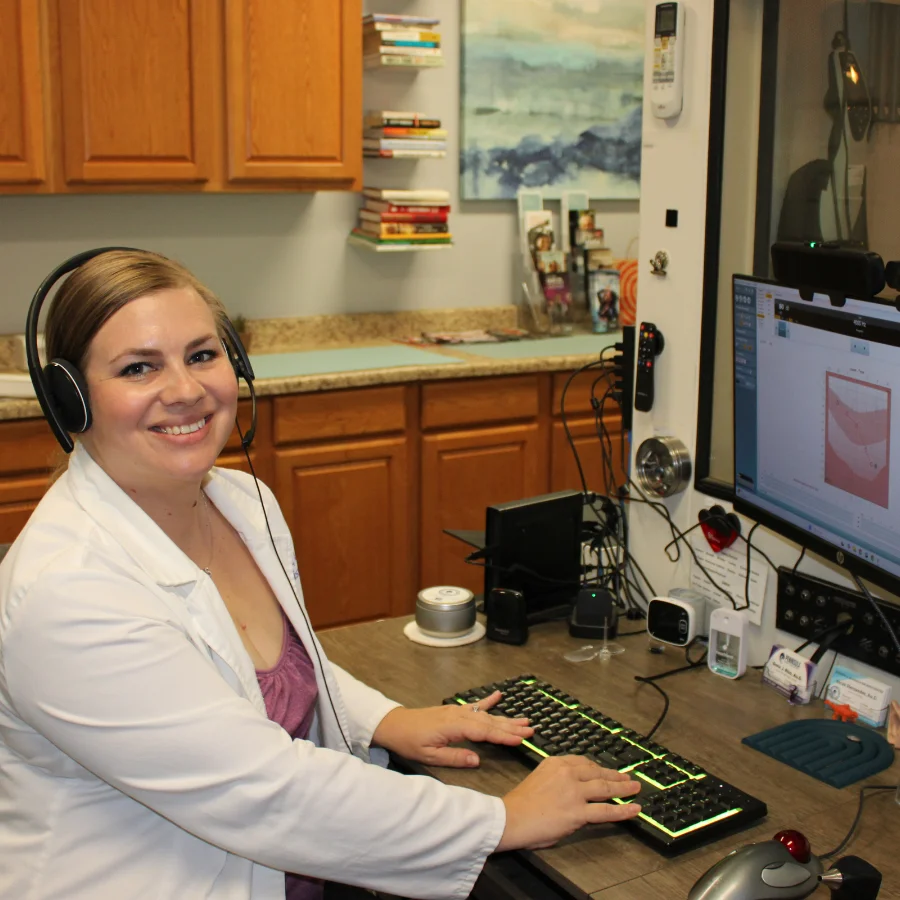
What Happens at Your Hearing Evaluation
Your appointment is completely pressure-free and takes about 30–45 minutes. Our Au.D.-credentialed audiologists walk you through every result so you leave with a clear picture of your hearing health — and honest guidance about what, if anything, comes next.
- Short Family/Medical history
- Visual inspection of your ear canals
- Pure-tone audiometry in a calibrated sound booth
- Bone conduction testing
- Speech discrimination and word recognition testing
- Speech in noise evaluation
- Middle ear testing/impedance
- Comprehensive audiogram interpretation and consultation
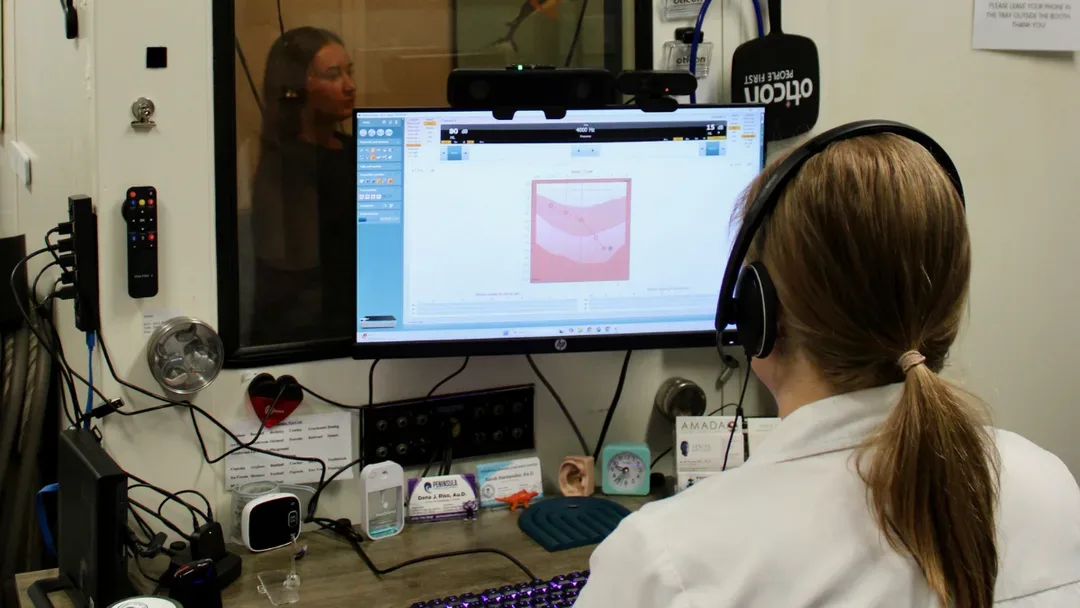
Why can't I hear in restaurants?
The beep-in-a-quiet-booth test was designed to map the softest sounds you can detect at different pitches. It does not measure how well your brain and ears work together when speech is competing with noise — which is exactly what happens in a restaurant, a family gathering, or a meeting room. Speech-in-noise testing (hearing speech clearly when background noise is present) fills that gap. It presents words or sentences against a controlled background of noise and measures how accurately you follow them. That score tells us something a quiet-booth test cannot: how much real-world difficulty you are likely experiencing, and — critically — how much benefit hearing aids would give you and how they should be programmed for your pattern of hearing. You will be asked to listen and repeat back words or sentences. There is nothing painful or uncomfortable about it.
What middle ear testing shows
When your ear feels full, blocked, muffled, or crackles when you swallow, the problem is often not the hearing nerve — it is the eardrum or the small air-filled space behind it. Tympanometry (a test that measures how your eardrum moves in response to gentle air pressure) checks that space without any discomfort. You will feel a brief moment of pressure in the ear canal, similar to a change in altitude, and then it is done. The results can show fluid or pressure building up behind the eardrum from allergies or a recent cold, eustachian tube dysfunction (ETD — when the tube that equalizes ear pressure is not opening and closing properly), or a small perforation in the eardrum. Each of those findings points in a different direction: fluid and ETD often need medical management rather than hearing aids, and a perforated eardrum requires an ear, nose, and throat specialist (ENT) before any amplification decisions are made. We will tell you clearly which category your results fall into.
Who should have a hearing evaluation
You do not need to be unable to hear to benefit from an evaluation. If you find yourself asking people to repeat themselves, turning up the television, missing words in phone calls, or feeling drained after conversations in noisy places, those are meaningful signals — even if people around you have not noticed anything. Adults over 50, people with a history of noise exposure at work or recreationally, anyone who has had repeated ear infections or pressure problems, and people who take medications known to affect hearing are all reasonable candidates for a baseline evaluation. An evaluation gives you a documented starting point, which is useful whether or not any treatment follows.
How we explain what we found
When the testing is complete, your audiologist will sit with you — not hand you a printout and send you on your way — and explain each finding in terms of what it means for your daily life. If the results are within normal limits but you are still struggling, we will explain what could account for that and what options exist. If the results show a pattern that hearing aids address well, we will show you the evidence from your own test scores. If the findings suggest a medical issue that should be addressed separately, we will tell you that plainly. The goal of the conversation is that you leave understanding your hearing, not just holding a piece of paper.